
The Death of Execution: Why Human Judgment Is Becoming More Valuable in AI-Powered Business Operations
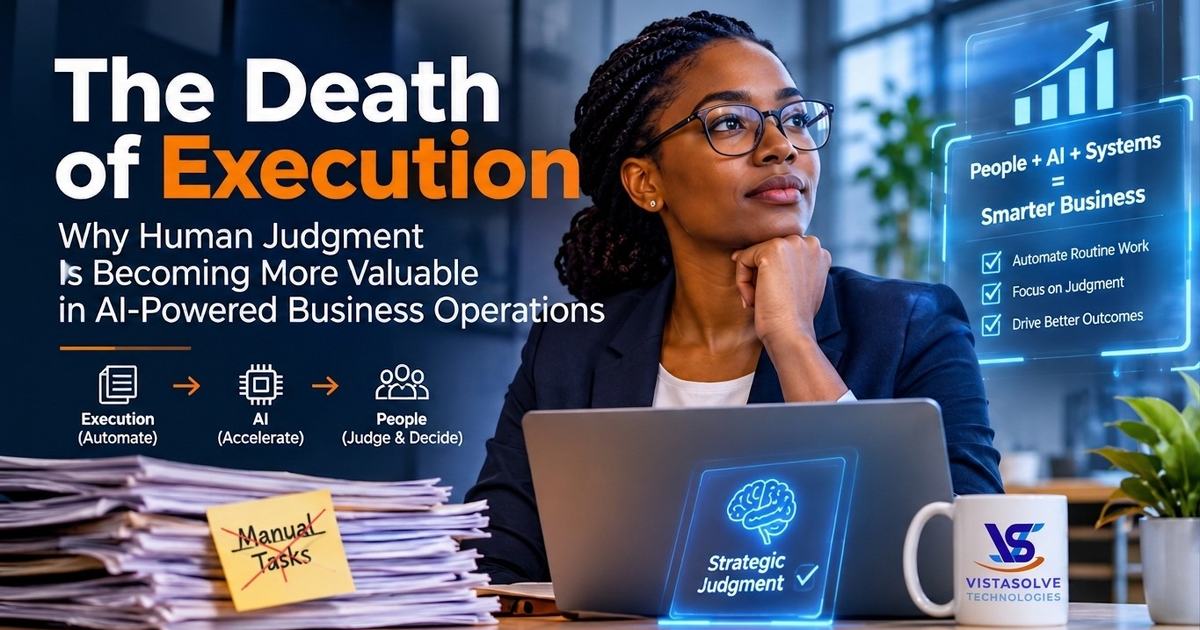
When producing the first version of something becomes inexpensive, the valuable part becomes deciding whether that output is correct, relevant, complete, appropriate, and aligned with the business.
AI is changing business operations by making routine execution faster, cheaper, and increasingly automated. As machines take on more of the work, a different type of work becomes more important: human evaluation, oversight, context, and judgment.
For businesses, the question is no longer simply:
How much work can our team execute?
It is increasingly:
How effectively can our people, AI, and systems work together?
The Death of Execution
Execution is becoming a commodity.
Writing routine emails, preparing basic reports, researching information, summarizing documents, transferring data, and producing first drafts can increasingly be handled by AI and automation.
That doesn't mean work has disappeared.
It means the location of value is changing.
When producing the first version of something becomes inexpensive, the valuable part becomes deciding whether that output is correct, relevant, complete, appropriate, and aligned with the business.
As AI reduces the cost of execution, human judgment becomes more important.
The Four Work Streams of AI-Assisted Operations
Business work can broadly be divided into four areas:
1. Transfer
Moving information between people, tools, and systems.
Examples include updating CRMs, transferring customer information, updating spreadsheets, and creating routine records.
Much of this can increasingly be automated.
2. Intelligence
Researching, summarizing, analyzing, drafting, and processing information.
AI is particularly powerful here because it can transform large amounts of information quickly.
But generating an answer is not the same as knowing whether the answer is correct or useful.
3. Alignment
Keeping people, tasks, and workflows coordinated.
Scheduling, reminders, approvals, status updates, and routine follow-ups can increasingly be handled through systems and automation.
This allows managers to spend less time chasing work and more time improving it.
4. Judgment
Deciding what should happen when there is no perfectly defined rule.
This includes evaluating AI outputs, handling exceptions, assessing risks, interpreting business context, managing client relationships, and making decisions.
And this is where the shift becomes particularly interesting.
See Where Your Operations Can Improve
Find out which parts of your workflow should be handled by people, AI, or systems—and where unnecessary manual work may be slowing your business down.
The New Operational Bottleneck: Evaluation
For years, the major constraint in many businesses was capacity.
There weren't enough people to process leads, prepare reports, answer inquiries, update systems, or complete administrative work.
AI changes that equation.
A business can now potentially produce more work than its people can properly evaluate.
The bottleneck moves from execution to evaluation.
The question is no longer only:
"Can we produce this?"
It becomes:
"Should we trust this?"
AI can generate ten customer responses in seconds. But which one is appropriate for this particular customer?
It can summarize a contract. But did it miss something important?
It can produce a business analysis. But does the conclusion actually make sense in the context of the company?
This is why simply adding AI tools does not automatically create an efficient operation.
More automation can create more problems if nobody is responsible for reviewing, correcting, and escalating what the automation produces.
What Is Human-in-the-Loop AI?
Human-in-the-loop AI is an operating model where AI handles automated or repetitive work while people provide oversight, context, evaluation, and decision-making where human judgment is required.
The goal isn't to make humans compete with machines at tasks machines perform better.
It is to give each part of the workflow to the component best suited to handle it.
For example:
Systems capture and organize information.
AI researches, summarizes, classifies, and drafts.
People review the output, handle exceptions, provide context, and make decisions.
This creates a more effective operating model than simply asking either people or AI to do everything.
The New Business Operating Model: People + AI + Systems
At Vistasolve, we think about modern business operations through three connected elements:
People
People provide judgment, accountability, business context, client relationships, supervision, communication, and exception handling.
AI
AI automates or accelerates repetitive and automatable work such as research, drafting, summarization, classification, and information processing.
Systems
Systems keep work organized, repeatable, and measurable through workflows, CRMs, automation, documentation, tracking, and reporting.
The objective isn't to automate everything.
It is to determine what should be automated, what should be systematized, and where human ownership is still required.
What This Means for Growing Service Businesses
This shift isn't limited to large technology companies.
Growing service businesses also have dozens of recurring operational activities:
- lead follow-up,
- CRM management,
- client onboarding,
- scheduling,
- document processing,
- customer communication,
- reporting,
- project coordination,
- and administrative work.
Not all of this needs a person.
But not all of it should be handed completely to AI either.
The better question is:
Which parts should be automated, which should be accelerated by AI, which should be organized through systems, and which require human judgment?
For example, a system can capture a new lead. AI can classify the inquiry and prepare a response. Automation can trigger follow-up.
But a person may still need to determine whether the lead is genuinely qualified, whether the response is appropriate, or whether the situation requires escalation.
That is human-in-the-loop business operations.
How Vistasolve Helps
Vistasolve is a Kenya-based business operations and digital support partner for growing service businesses.
We help businesses run their operations more effectively by combining People, AI, and Systems.
Our role isn't simply to provide another pair of hands.
We help organize recurring workflows so that:
- people handle work requiring judgment and accountability,
- AI handles work that can be automated or accelerated,
- systems keep processes structured and measurable.
The goal is simple:
Make the work behind the business easier to execute, easier to manage, and easier to measure.
See How People, AI, and Systems Work Together
Explore how Vistasolve helps growing service businesses organize recurring work, automate what can be automated, and keep people focused on the work that requires judgment.
The Executive Challenge
Take one recurring workflow in your business and ask:
- Can this be automated?
- Can AI accelerate it?
- Can a system make it repeatable?
- Does it require human judgment?
- Who owns the exceptions?
You may discover that your business doesn't simply need more people.
It may need a better allocation of work between People, AI, and Systems.
AI is making execution cheaper.
Systems are making execution more consistent.
But people remain responsible for the judgment that turns execution into useful business outcomes.
The future of business operations isn't people versus AI.
It's People + AI + Systems working together.
